
What Is Clean Beauty and Why It Matters
Finding truly clean skincare can feel confusing when every brand claims to be safe and natural. For many eco-conscious women, skipping hidden toxins and supporting ethical practices is more than a trend—it is a non-negotiable part of self-care. This guide breaks down the real meaning of clean beauty, untangles common myths, and highlights how ingredient safety and transparency can empower your healthiest glow.
Table of Contents
- Defining Clean Beauty And Common Misconceptions
- Types Of Clean Beauty: Natural, Organic, And Non-Toxic
- Key Ingredient Standards And Safety Practices
- Ethical Impact: Cruelty-Free And Sustainable Production
- Global Regulations And Labeling Challenges
- Risks, Marketing Pitfalls, And Consumer Responsibilities
Key Takeaways
| Point | Details |
|---|---|
| Clean Beauty Philosophy | Focuses on ingredient safety, transparency, and responsible manufacturing methods, challenging traditional beauty standards. |
| Ingredient Categories | Clean beauty includes natural, organic, and non-toxic products, each with unique safety and sourcing standards. |
| Consumer Responsibility | Consumers should research product ingredients and certifications to make informed choices amid misleading marketing claims. |
| Regulatory Challenges | The clean beauty landscape faces complexities due to varied global regulations, necessitating careful compliance strategies for brands. |
Defining Clean Beauty and Common Misconceptions
The clean beauty movement represents a transformative approach to skincare and cosmetics, emphasizing ingredient safety, transparency, and environmental consciousness. Unlike traditional beauty standards, this philosophy goes beyond marketing claims to prioritize scientifically informed, health-conscious product development.
Clean beauty fundamentally challenges conventional cosmetic manufacturing by focusing on eliminating potentially harmful ingredients. The movement emerged from consumer demand for safer, more responsible skincare alternatives that minimize exposure to potentially toxic chemicals. However, the term remains frustratingly ambiguous, lacking a universally accepted definition.
Key characteristics of clean beauty include:
- Avoiding known harmful synthetic chemicals
- Prioritizing natural and organic ingredients
- Emphasizing ingredient transparency
- Supporting environmentally sustainable production methods
- Focusing on product safety beyond traditional regulatory standards
Contrary to popular belief, “clean” does not automatically mean “natural” or “organic”. Many consumers mistakenly assume that natural ingredients are inherently safer, but scientific research suggests this isn’t always true. Some natural compounds can be more allergenic or irritating than carefully formulated synthetic alternatives.
Clean beauty is about intelligent ingredient selection, not blanket elimination of all synthetic materials.
The clean beauty landscape remains complex and largely unregulated. While the movement aims to protect consumer health, it simultaneously highlights the need for more comprehensive cosmetic ingredient research and standardized safety protocols.
Pro tip: Always read ingredient labels carefully and research specific components rather than relying solely on marketing claims about “clean” or “natural” products.
Types of Clean Beauty: Natural, Organic, and Non-Toxic
The clean beauty landscape encompasses three distinct yet interconnected categories: natural, organic, and non-toxic products. Each classification represents a unique approach to ingredient safety and environmental consciousness, offering consumers nuanced options for responsible skincare and cosmetic choices.
Natural beauty products prioritize ingredients sourced directly from botanical and mineral origins, emphasizing minimal processing and plant-based components. These formulations typically avoid synthetic chemicals, focusing instead on certified non-toxic beauty standards that ensure ingredient transparency and safety.
Key distinctions between clean beauty types include:
-
Natural Products:
- Derived primarily from plant-based sources
- Minimal chemical processing
- Emphasis on raw, unrefined ingredients
-
Organic Products:
- Certified organic ingredient sourcing
- No synthetic pesticides or fertilizers
- Strict agricultural production standards
-
Non-Toxic Products:
- Rigorously tested for harmful ingredient absence
- Compliance with safety certifications
- Focus on human and environmental health
Contrary to common misconceptions, “non-toxic” does not automatically mean “100% natural”. Many scientifically formulated synthetic ingredients can be safer and more stable than their natural counterparts. Non-toxic products undergo extensive testing to ensure they meet stringent safety standards, regardless of whether ingredients are synthetic or natural.
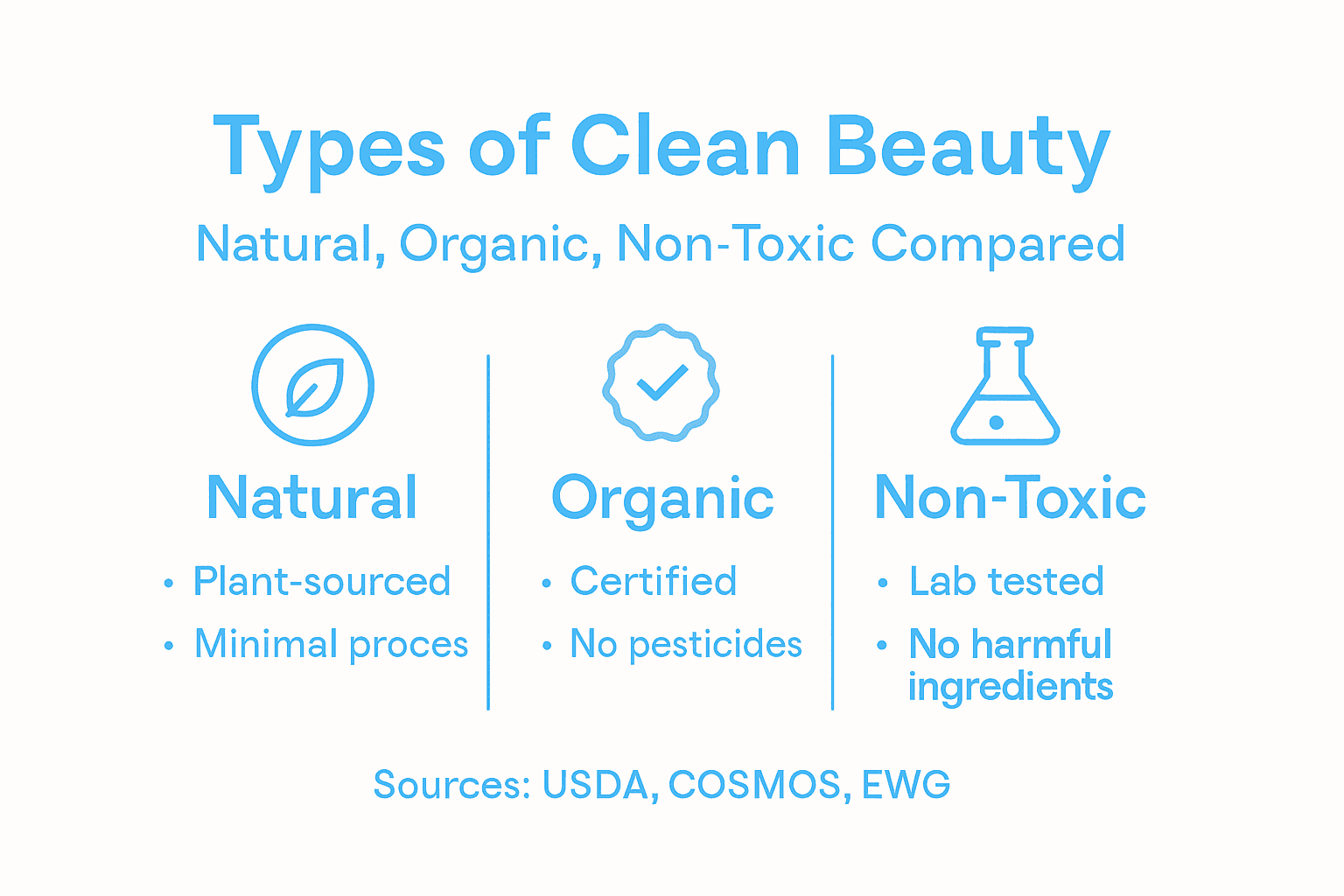
Here’s a clear comparison of clean beauty product categories:
| Category | Ingredient Source | Certification Focus | Typical Consumer Benefit |
|---|---|---|---|
| Natural | Botanical and mineral | Ingredient purity | Minimal processing, plant-based |
| Organic | Organic agriculture | USDA, Cosmos, etc. | No synthetic pesticides/fertilizers |
| Non-Toxic | Synthetic or natural | Safety testing, EWG Verified | Verified safe, allergy reduction |
Non-toxic clean beauty represents a sophisticated approach to product development, prioritizing scientific validation over marketing claims.
Certification plays a crucial role in substantiating clean beauty claims. Reputable organizations like USDA Organic, Cosmos Organic, Non-GMO Project, and EWG Verified provide consumers with reliable indicators of product safety and ingredient integrity.
Pro tip: Always cross-reference product claims with independent certification standards and research specific ingredient safety before making purchasing decisions.
Key Ingredient Standards and Safety Practices
The clean beauty industry has established sophisticated ingredient standards that go far beyond traditional cosmetic regulations. Rigorous production standards now encompass comprehensive safety assessments, ethical sourcing, and environmental sustainability, transforming how manufacturers approach product development.
Most clean beauty brands have committed to excluding over 1,400 potentially harmful chemicals from their formulations. This proactive approach involves multiple layers of ingredient evaluation, including detailed assessments of toxicological properties, potential allergens, and long-term health impacts.
Key safety practices in clean beauty include:
-
Chemical Screening:
- Comprehensive toxicity testing
- Allergen identification
- Carcinogen and reproductive toxin assessment
-
Sourcing Standards:
- Transparent supply chain documentation
- Ethical ingredient procurement
- Sustainable harvesting practices
-
Manufacturing Protocols:
- Good Manufacturing Practices (GMP)
- Third-party certification verification
- Continuous quality control monitoring
The European Union has been particularly progressive in establishing comprehensive safety frameworks. Regulatory bodies now mandate extensive testing protocols that examine not just immediate skin reactions, but potential long-term physiological impacts of cosmetic ingredients.
Safety in clean beauty means understanding ingredients, not just avoiding them.
Advanced technologies like blockchain are increasingly being utilized to ensure complete traceability and transparency in ingredient sourcing. This technological approach allows consumers to track product components from origin to final formulation, providing unprecedented insight into manufacturing processes.
Pro tip: Request ingredient origin documentation from brands and use online resources to research specific component safety before making skincare purchases.
Ethical Impact: Cruelty-Free and Sustainable Production
The clean beauty movement has dramatically transformed industry standards by prioritizing ethical production practices that go far beyond traditional cosmetic manufacturing. Consumer-driven ethical behavior is reshaping how brands approach product development, with younger generations leading the charge toward more responsible beauty solutions.
Sustainable practices in the beauty industry now encompass a holistic approach that considers environmental impact, animal welfare, and social responsibility. This comprehensive perspective challenges manufacturers to rethink every aspect of product creation, from ingredient sourcing to final packaging.
Key ethical considerations in clean beauty include:
-
Cruelty-Free Commitments:
- No animal testing at any production stage
- Certification from recognized animal welfare organizations
- Transparent testing methodologies
-
Sustainable Sourcing:
- Environmentally responsible ingredient procurement
- Support for local and indigenous communities
- Minimal ecological disruption
-
Packaging Innovations:
- Recyclable and biodegradable materials
- Reduced plastic consumption
- Minimal environmental footprint
The challenges facing ethical beauty production are significant. While consumer demand continues to grow, brands must navigate complex issues like greenwashing, high production costs, and limited regulatory frameworks. Transparency becomes crucial in demonstrating genuine commitment to sustainable practices.
Ethical beauty is about making conscientious choices that benefit people, animals, and the planet.
Certifications and third-party verifications have become essential tools for brands seeking to demonstrate their commitment to ethical production. These rigorous assessment processes help consumers make informed decisions and hold manufacturers accountable for their environmental and social impacts.
Pro tip: Research brand certifications and look for detailed sustainability reports that provide concrete evidence of ethical commitments beyond marketing claims.
Global Regulations and Labeling Challenges
The clean beauty landscape is dramatically complicated by the intricate web of global cosmetic regulatory frameworks that vary significantly across different international markets. Each region maintains unique requirements for product safety, ingredient disclosure, and manufacturing standards, creating a complex compliance environment for beauty brands.
Regulatory bodies worldwide approach cosmetic oversight with distinct methodologies, reflecting diverse cultural, scientific, and consumer protection priorities. The European Union, United States, Canada, Japan, China, and Brazil each maintain sophisticated yet fundamentally different regulatory approaches that challenge manufacturers seeking global market access.
Key regulatory complexities include:
-
Ingredient Restrictions:
- Varying banned substance lists
- Different toxicological assessment standards
- Regional ingredient safety thresholds
-
Labeling Requirements:
- Multilingual ingredient declarations
- Specific packaging information mandates
- Detailed safety warning protocols
-
Compliance Challenges:
- Pre-market safety assessments
- Ongoing product monitoring
- Adverse event reporting mechanisms
International harmonization efforts through organizations like the International Cooperation on Cosmetics Regulation (ICCR) attempt to standardize approaches, but significant disparities remain. Brands must invest considerable resources in understanding and navigating these complex regulatory landscapes.
Regulatory compliance is not just about following rules, but protecting consumer health across diverse global contexts.
The emergence of new legislation, such as the US Modernization of Cosmetics Regulation Act (MoCRA), demonstrates the evolving nature of global cosmetic regulation. These changes require brands to remain agile and proactive in their compliance strategies.
Major global regions approach clean beauty regulation differently:
| Region | Key Regulatory Body | Ingredient Policy | Labeling Requirement |
|---|---|---|---|
| European Union | European Commission | Strict bans, over 1,400 chemicals | Multi-language, safety warnings |
| United States | FDA, MoCRA | Fewer bans, focus on safety | Ingredient list, no pre-market approval |
| Japan | Ministry of Health, Labour & Welfare | Rigorous safety testing | Detailed ingredient disclosure |
| Brazil | ANVISA | Several restricted substances | Specific packaging, safety protocols |
Pro tip: Consult regional regulatory experts and invest in comprehensive compliance mapping to successfully navigate international beauty market requirements.
Risks, Marketing Pitfalls, and Consumer Responsibilities
The clean beauty movement confronts significant challenges, particularly around marketing claims and consumer deception. Without standardized regulatory oversight, brands can exploit consumer fears and goodwill by using ambiguous terms like ‘natural’ and ‘non-toxic’ without substantive scientific evidence.
The beauty industry has long been criticized for creating unrealistic expectations and potentially misleading marketing strategies. Many brands capitalize on consumer anxieties about health and environmental impact, deploying sophisticated marketing techniques that blur the lines between genuine product safety and opportunistic messaging.
Key consumer awareness strategies include:
-
Marketing Red Flags:
- Vague terminology without scientific backing
- Undefined claims of ‘natural’ or ‘pure’
- Emotional manipulation tactics
-
Self-Protection Techniques:
- Independent ingredient research
- Verification of third-party certifications
- Critical evaluation of marketing language
-
Educational Priorities:
- Understanding ingredient complexities
- Recognizing greenwashing techniques
- Developing scientific literacy
Consumers must become active participants in their product selection, moving beyond passive acceptance of marketing narratives. This requires developing critical thinking skills and a nuanced understanding of ingredient safety and environmental impact.
Consumer education is the most powerful defense against misleading marketing claims.
The responsibility for driving meaningful change lies not just with brands, but with informed consumers who demand transparency, scientific rigor, and genuine commitment to ethical practices.
Pro tip: Develop a personal research protocol that includes checking ingredient lists, consulting scientific databases, and maintaining a healthy skepticism toward marketing claims.
Discover Truly Clean Beauty with Passé Daisy
Navigating the complex world of clean beauty can feel overwhelming. The challenge lies in finding skincare products that blend transparency, safety, and efficacy without falling for vague marketing claims or confusing labels. At Passé Daisy, we understand your desire for scientifically validated, cruelty-free formulas that honor both your skin and ethical standards. Our collection reflects a commitment to ingredient integrity, non-toxic formulations, and sustainable practices that align with the clean beauty principles you care about.
Explore our carefully crafted range by visiting All Products - Skincare & Beauty | Passé Daisy. Start your journey toward radiant, healthy skin with confidence knowing every product is designed to deliver visible results while embracing true clean beauty values. Don’t settle for uncertainty—make the switch today at Passé Daisy and experience skincare that respects your health, the environment, and your standards.
Frequently Asked Questions
What is clean beauty?
Clean beauty refers to skincare and cosmetic products that prioritize ingredient safety, transparency, and environmental sustainability, focusing on eliminating harmful chemicals and supporting ethical practices.
How do clean beauty products differ from traditional beauty products?
Clean beauty products avoid known harmful synthetics and emphasize natural and organic ingredients, whereas traditional beauty products may include potentially toxic chemicals and lack transparent ingredient disclosure.
Are natural ingredients always safer than synthetic ones in clean beauty?
No, many natural ingredients can be allergenic or irritating. Clean beauty focuses on intelligent ingredient selection, prioritizing safety over the assumption that natural is always better.
What certifications should I look for in clean beauty products?
Look for certifications like USDA Organic, Cosmos Organic, Non-GMO Project, and EWG Verified, which indicate a product’s commitment to ingredient safety, ethical sourcing, and environmental sustainability.
Recommended
- Role of Luxury in Skincare: Elevating Results Ethically – Passé Daisy
- 7 Smart Tips for Eco-Friendly Skincare Practices – Passé Daisy
- How to Choose Skincare Ingredients for Your Skin Naturally – Passé Daisy
- Defining Active Ingredients for Effective Skincare – Passé Daisy
- Benefits of Clean Ingredients for Modern Beauty
- What Are Vegan Beauty Products and Why They Matter – The Soap Lab Scotland
Let customers speak for us
Their packaging is adorable and I’m literally obsessed with their vitamin c moisturizer.
One of my faves! Not too heavy & leaves my skin glowy/bright. The consistency wears perfect under makeup.

Absolutely love this serum! After a few weeks of consistent use, my lashes became longer and fuller, and my brows look much healthier. It’s gentle, easy to apply, and actually delivers visible results. Highly recommend! 💛
Absolutely love this serum! After a few weeks of consistent use, my lashes became longer and fuller, and my brows look much healthier. It’s gentle, easy to apply, and actually delivers visible results. Highly recommend! 💛

I’ve really enjoyed using this serum. It was easy to incorporate into my routine, and my lashes look healthier and fuller. I’m very happy with the results and would recommend it!
I absolutely LOVE this serum! After having a terrible accident with an eyelash curler that ripped out a huge chunk of my lashes, this stuff truly helped grow my lashes back longer and fuller! It is also does not irritate my eyes at all which is a huge plus! Totally worth it!

I’ve been using this serum for a little bit over a week and I have nothing but good things to say. There has been no irritation to my eyelids upon application and after, and I see a change in the fullness of my lashes already. I highly recommend.
I’ve been really enjoying this lash serum! It’s lightweight, easy to apply, and has become such a simple part of my nightly routine. I also love that it doesn’t feel sticky or heavy after application. The packaging is beautiful, and the overall experience feels really luxurious. I’m excited to keep using it and can’t wait to see even more results over time. Definitely recommend if you’re looking to support healthier-looking lashes!
I’ve been really enjoying this lash serum! It’s lightweight, easy to apply, and has become such a simple part of my nightly routine. I also love that it doesn’t feel sticky or heavy after application. The packaging is beautiful, and the overall experience feels really luxurious. I’m excited to keep using it and can’t wait to see even more results over time. Definitely recommend if you’re looking to support healthier-looking lashes!
I am absolutely in love with the Celestial Age-Defy Peptide Serum! Finding an anti-aging product that actually delivers visible results can be a challenge, but this serum is incredible. After just two weeks of using it morning and evening, I can already see a wonderful difference. My skin feels noticeably smoother, firmer, and deeply hydrated. It does an amazing job at softening fine lines and giving the skin a healthy, youthful glow. The texture is lightweight, absorbs beautifully, and leaves the skin feeling great. Highly recommend!

I’ve been using the Multi Peptide Eyelash Serum as part of my routine, and one of the things I like most is that it’s prostaglandin-free, vegan, and cruelty-free. The applicator is very precise, making it easy to apply to both my lashes and brows. So far, I’ve really enjoyed using it and I’m looking forward to seeing my results with continued use. Overall, it’s been a great addition to my beauty routine.
Just started using this serum and I cannot say enough good things about it. It’s so easy to add to my daily routine and really helps extenuate my natural features. Will be purchasing again!! 5 stars easy!!